

15 Reunion Activities That Actually Get Every Generation Involved
Most reunion game lists are built for one age group and quietly fail everyone else. Here's how to structure activities that work for toddlers, teens, and grandparents alike.

I ran a family reunion two summers ago where the organizer had printed out a list of "classic reunion games" she found online. Three-legged race. Egg toss. Trivia about the family tree. By hour two, the eight-year-olds had wandered off to find shade and a phone, the teenagers had never left the phone in the first place, and the grandparents were parked at a picnic table watching everyone else sweat. The games weren't bad. They just worked for one narrow band of people — adults 25 to 45 who still had knees that enjoyed a three-legged race.
That's the pattern I see over and over. Most "reunion activity" lists are written for a single imagined attendee, usually a fit thirty-something who loves organized fun. Real reunions have a four-year-old, a fourteen-year-old, a forty-year-old, and an eighty-year-old all standing in the same backyard, and an activity that delights one of them can actively exclude another. A relay race that's a blast for cousins under twelve is a hard no for anyone with a hip replacement. A "share a memory" circle that moves grandma to tears will make a bored twelve-year-old ask when lunch is.
So instead of one list, think in two modes: low-key gatherings where people mostly want to sit and talk, and high-energy gatherings where people want to move. Most reunions actually need both, at different points in the day.
For the low-key stretch
A rotating photo table. Set out a few boxes of old family photos — the physical kind, if anyone still has them, or a laptop slideshow if not — and let people wander over in their own time. This works because it doesn't ask for a scheduled block of everyone's attention. Grandpa can hold court explaining who's in a 1978 photo for twenty minutes while the rest of the party does something else entirely. I've watched this become the actual centerpiece of a reunion more than once.
A "who am I" name-tag icebreaker for the first thirty minutes. Give everyone a sticky note with a fact about themselves — favorite childhood pet, first job, most embarrassing nickname — and have people guess whose note is whose as they say hello. It gives shy relatives and awkward in-laws a built-in reason to talk to someone they don't know instead of standing near the drink cooler pretending to check their phone.
A family trivia round, but written by a kid. Skip the version where one adult quizzes everyone on genealogy facts nobody remembers. Hand a twelve-year-old cousin a notepad an hour into the party and have them go interview three or four relatives for weird facts, then read the questions aloud later. The questions end up funnier and stranger than anything an adult would write, and it gives one restless kid a job.
Cornhole or a similar seated-adjacent yard game. Cornhole works across generations because you can play it standing still, it doesn't require running, and a seventy-year-old can beat a twenty-year-old on a good throw. Bags and boards are cheap to rent or buy, and it runs itself once it's set up — nobody needs to referee it.
For the high-energy stretch
A water balloon or sponge relay, sized by age group, not mixed. The mistake is putting a six-year-old on a team against a sixteen-year-old and calling it fair. Split it into an under-10 heat and an open heat instead, and let the little kids' round get its own applause. It sounds obvious once you say it, but I've seen it get skipped constantly because organizers default to "everyone together" as the friendly option, when actually it just guarantees somebody loses badly and feels bad about it.
A scavenger hunt built around family knowledge, not physical stuff. Instead of "find a red leaf," try clues like "find someone who was at the 2003 reunion" or "find the person who's driven the farthest to be here." It gets people talking to relatives they don't know well, and it works for a twelve-year-old and a sixty-year-old equally, since it's about conversation, not speed.
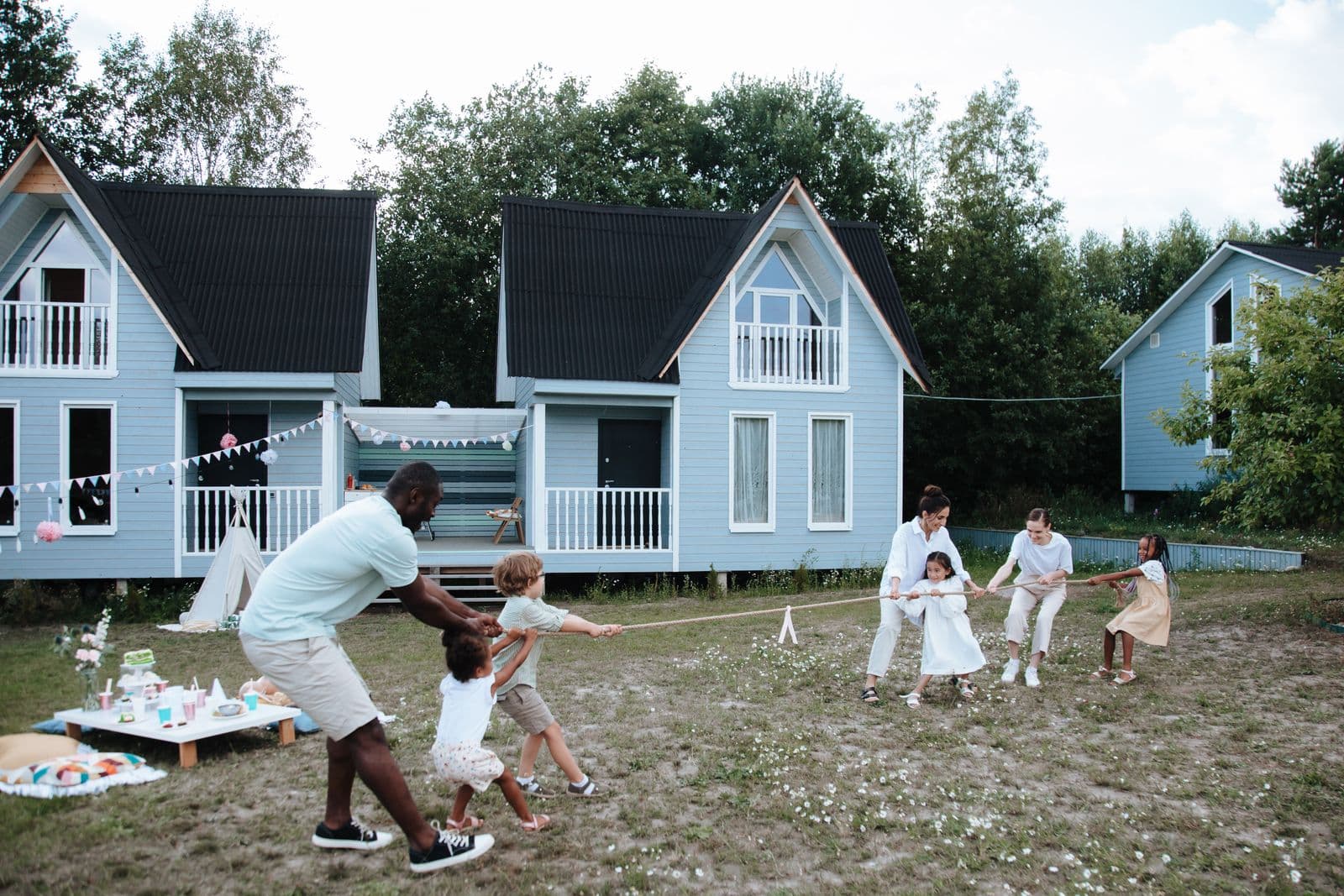
Tug of war by generation, not by family branch. Splitting along family-branch lines tends to reopen old sibling rivalries nobody wants revisited at a reunion. Splitting by generation — cousins under 20 versus everyone 40 and up, say — turns it into a bit, gets genuine laughs, and doesn't put anyone in the position of literally competing against their own sibling.
A simple obstacle course for kids, with a "grown-up heckler" role for anyone who doesn't want to run it. Not every adult wants to physically participate, and that's fine — give them a job as the announcer or scorekeeper instead of leaving them standing around unsure what to do.
Structuring the actual day
The reunions that flow well tend to open low-key — arrival, food, the photo table, some milling around — then build into one or two higher-energy activities mid-afternoon once people have eaten and warmed up socially, then wind back down for photos and goodbyes. Don't open with the tug of war. Nobody's ready for that at 11am, and half your crowd hasn't shown up yet.
If you're planning around 30 to 50 people, you can run most of these with minimal equipment and one person coordinating. Past 80 or so, assign an actual point person for each activity block, because "everyone will just kind of know when it's cornhole time" stops working once the crowd gets big enough that half of it can't hear you shout across the yard.
One thing that consistently helps activities read as "an event" instead of "some cousins standing in a yard": matching shirts. It sounds small, but when you're trying to organize a scavenger hunt team or figure out who's on the "under 40" tug of war side, color-coded event t-shirts do double duty as team markers and as the thing that makes your reunion photos actually look like a reunion instead of a random cookout. We've built shirt orders around exactly this — one color per generation, or one per family branch, whatever splits your particular group in a way that makes sense.
You can see how other families have used this in our gallery — a few of those photos are from reunions where the shirts literally doubled as game team colors. If you want to look at the fuller range of what we make beyond tees, from hoodies for a cooler evening session to drinkware people actually keep, check out the full product lineup. And once you've got a rough headcount and a sense of what your day looks like, request a quote — it takes a few minutes and gets you real pricing instead of a guess.
The bigger point, underneath all of this: the goal isn't finding activities that are universally fun. That's a myth. The goal is having enough range in your lineup that every age group gets at least one moment that's built for them, and enough downtime that nobody feels forced to participate in something that doesn't fit their body or their patience level. Get that balance right and the reunion runs itself.
Equipment you actually need, and what you can skip
Reunion planning threads online tend to make this sound more expensive than it is. For the activities above, you're realistically looking at a cornhole set, a bag of water balloons or a pack of sponges, sticky notes and pens for the name-tag icebreaker, and whatever's already sitting in a phone or an old shoebox for the photo table. That's it. I've seen organizers spend real money on rental obstacle courses and bounce houses that sat mostly unused because nobody built in enough unstructured time for kids to actually want them. Spend on the things that get used constantly — shade, seating, and drinks — before you spend on a single expensive centerpiece activity.
The mistake I see most often
Organizers frequently plan the whole day around what they personally enjoyed at reunions growing up, without checking whether the current guest list matches that memory. A reunion that was mostly cousins in their twenties a decade ago might now include six kids under ten and three grandparents who've since had knee surgery. Look at your actual RSVP list — not who usually comes, but who said yes this year — before finalizing the lineup. If you've got a bigger toddler contingent than usual, that changes what "high energy" should even mean; a toddler's idea of high energy is chasing bubbles, not running a relay.
It also helps to assign one low-pressure job to relatives who tend to hover at the edges of group activities. Not everyone wants to play cornhole or run a scavenger hunt, and that's fine — but handing someone the job of "official photographer" or "scorekeeper" gives them a reason to be near the action without forcing them to participate directly. I've watched shy teenagers turn into the most enthusiastic person at the party once they had an actual role instead of an open invitation to just join in.
Ready to bring your event to life?
Tell us what you're planning and we'll put together a custom quote for apparel and merch made just for your group.
Start Your QuoteMore on Activities & Entertainment
Team-Building Activities That Don't Feel Like Team Building
Trust falls and forced vulnerability circles make people perform enthusiasm they don't feel. Here's how to pick corporate retreat activities with an actual point.

Icebreakers and Games That Get Every Generation Talking
Reunion icebreakers have a harder job than party games at a wedding: reconnecting people who used to be close. Here's how to pick and size the right one.